A guideline-mandated cardiac maneuver, performed blind.
We built the instrument that measures it. The Goal-Directed Valsalva Device gives the echo lab real-time pressure and timing feedback — and the Valsalva Effort Index, the first single number that quantifies how much strain a patient actually delivered.
Investigational device. Not cleared by the FDA. Not available for sale. Images show an engineering prototype and are not a commercial product.
goal-directed Valsalva reclassified nearly twice as many patients as obstructive versus self-directed technique1
of 40 surveyed US cardiologists found the device appealing; 91% chose it over standard of care3
PCT/US26/19884 (March 2026) — the Valsalva Effort Index is claimed
Class II pathway defined with an engaged FDA consultant; predicate device identified
Everyone is told to do it. No one can tell whether it was done.
ACC/AHA guidelines require provocative maneuvers during echocardiography to unmask left ventricular outflow tract obstruction in hypertrophic cardiomyopathy. In practice the Valsalva maneuver is coached by voice, judged by eye, and recorded as a checkbox — with no pressure, no timing, and no record of what the patient actually did.
Inconsistent patient performance
The single biggest barrier named by surveyed cardiologists. Effort varies between patients, between visits, and between attempts on the same afternoon.
No standardized coaching
Technique varies by sonographer and by institution. Nothing in the workflow enforces a pressure target or a hold duration, so the maneuver is neither reproducible nor auditable.
Nothing to chart
A negative provocation study cannot be distinguished from an inadequate one. There is no number in the report to say whether the maneuver itself was good enough to trust.
Across 203 echocardiograms in patients on myosin-inhibitor therapy, a goal-directed Valsalva reclassified nearly twice as many patients as obstructive — 31% versus 16% on the first study after starting therapy. Roughly half the obstruction the goal-directed technique found was invisible to the self-directed one.
Bavishi et al., JACC: Advances, 20251
A coach the patient can see, and a measurement the lab can keep.
The Goal-Directed Valsalva Device reads airway pressure through a disposable mouthpiece and drives a purpose-built touchscreen: a live pressure column against the target band, a hold timer, and spoken coaching in English or Spanish. The sonographer taps Start and keeps both hands on the probe.
In the echo lab it coaches the published goal-directed protocol — 40 mmHg held for 10 seconds1. The SVT configuration follows the REVERT protocol's 15-second hold2. Both are set in firmware, not left to the patient.
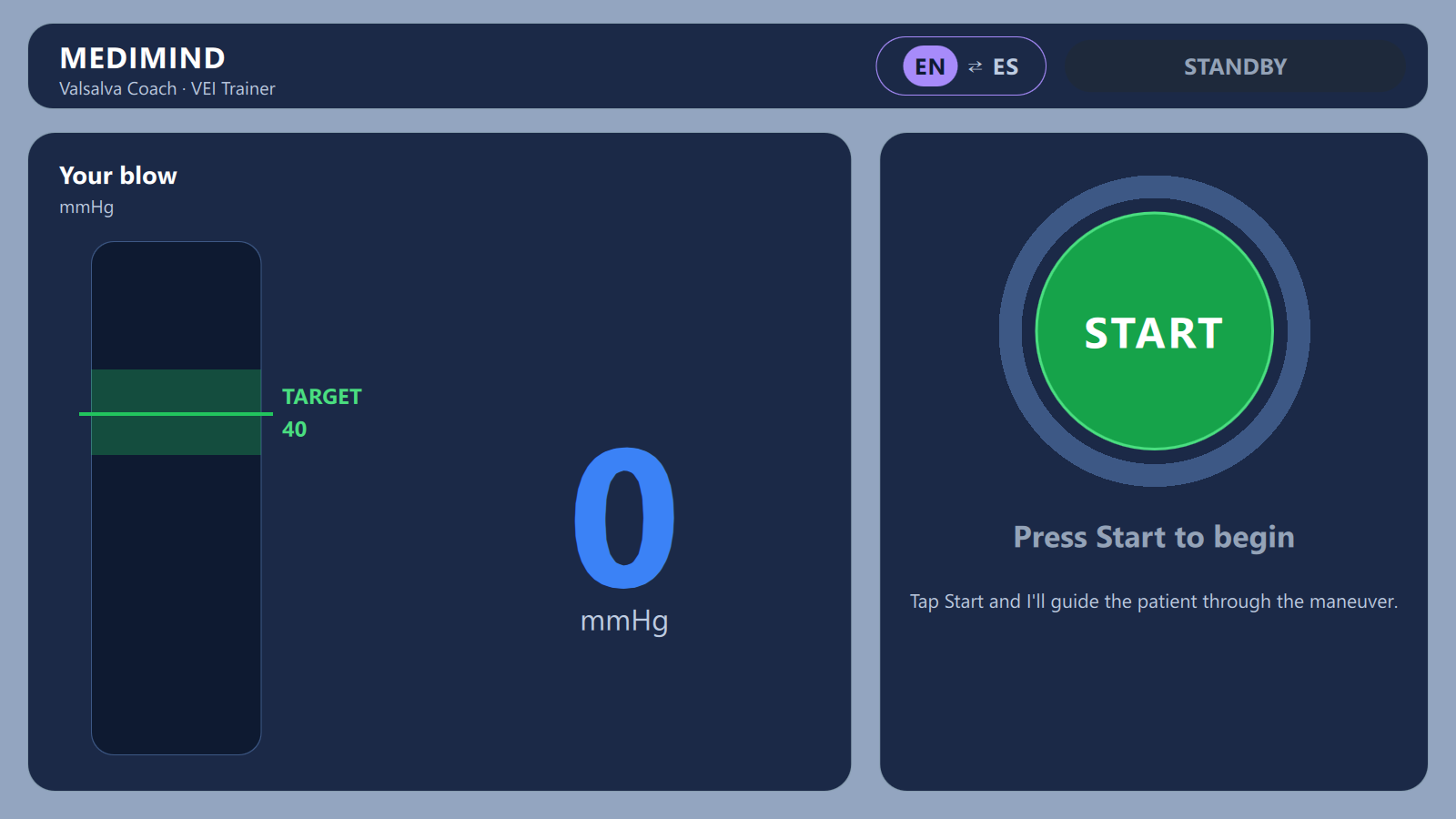
One control, in the middle of the screen
The device sits silent until the tech taps Start. It then auto-zeros to ambient pressure, speaks the instructions to the patient, and arms itself.
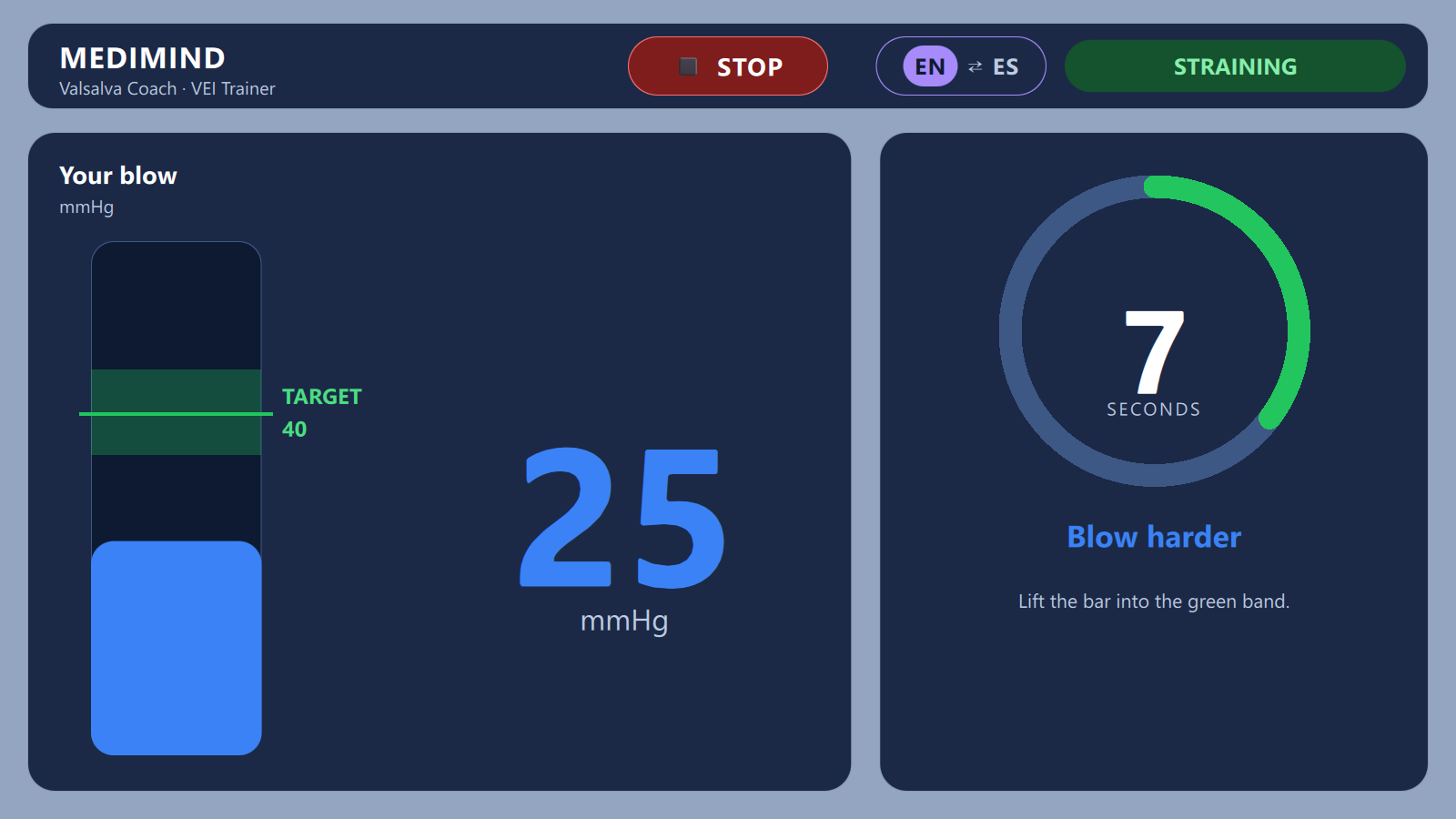
Correction while it still matters
Below target the column turns blue and the device says so — out loud and on screen — while the strain is still in progress. The patient corrects the same attempt instead of repeating the study.
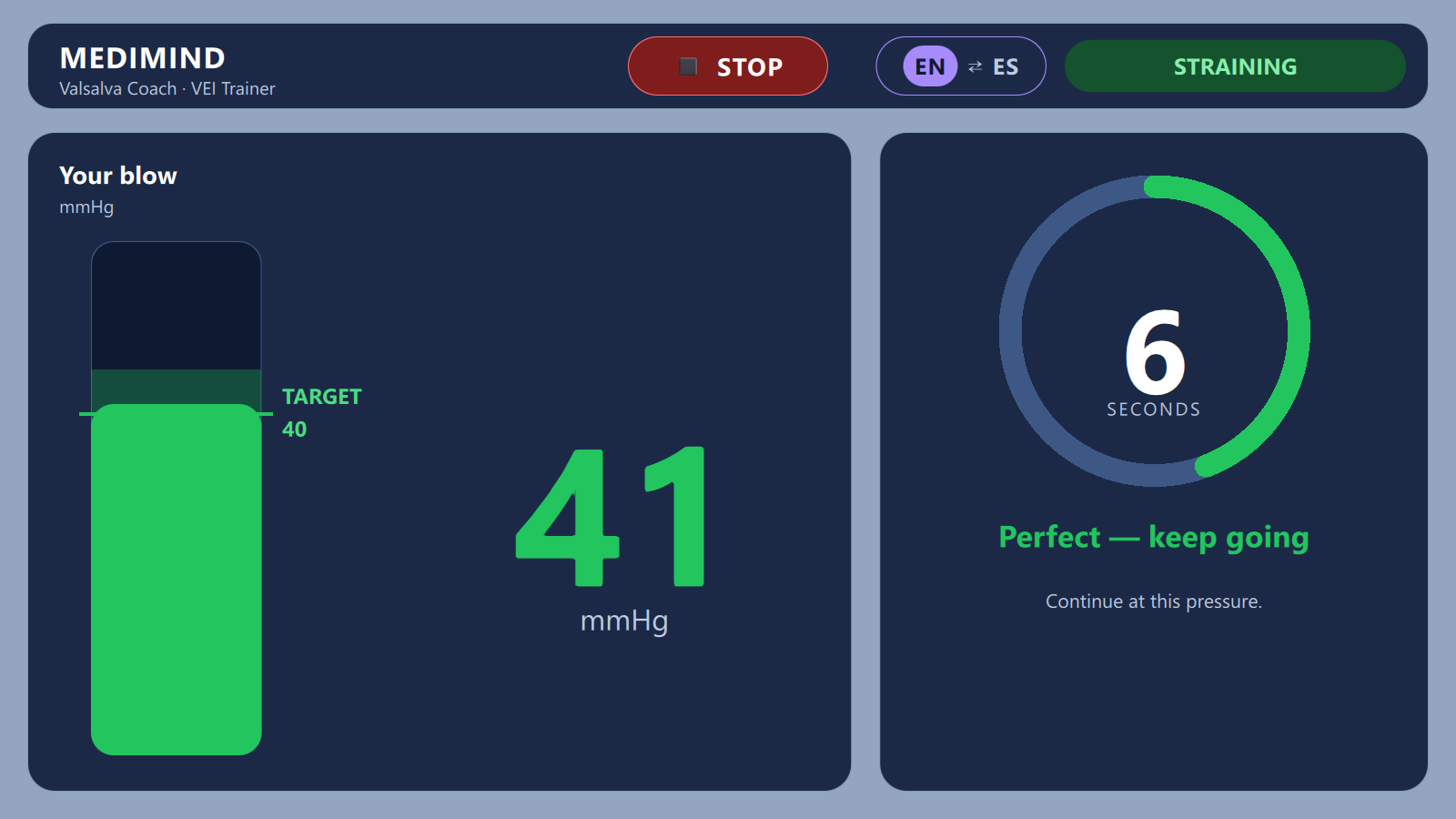
Two panels, nothing else
Mid-strain the patient has exactly two things to look at: how hard, and how much longer. Everything else is deliberately withheld — an earlier build showed a live effort graph and testers found it distracting.
A number, a verdict, and a history
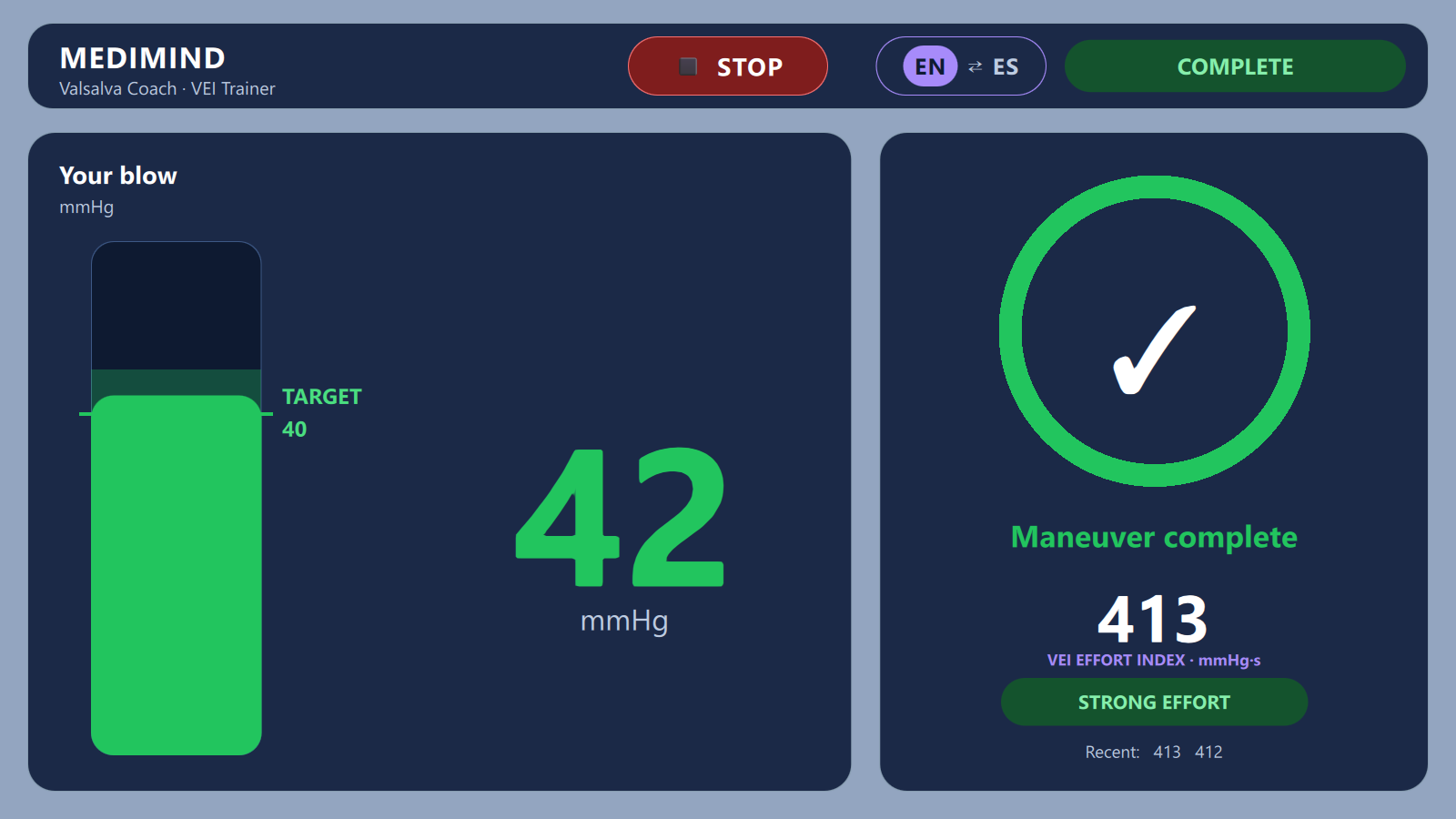
When the window closes the device reports the Valsalva Effort Index for that attempt, grades it, and shows the patient's recent scores — so the tech can see at a glance whether this study is comparable with the last one.
Not "did they blow?" — but how much.
The VEI is the integral of strain pressure over the hold window: the area under the patient's own pressure curve, in mmHg·seconds. One number that captures both how hard and how long, and that behaves the same way on any day, in any lab.
- Confirms adequacy. A negative study performed with a strong effort means something different from a negative study performed with a weak one.
- Makes serial studies comparable. Gradient changes during drug titration can be attributed to the drug rather than to a better or worse blow.
- Creates a chartable metric. A reportable quality measure for the study, and the basis of a data asset no analog device can produce.
- It is the protected core. The VEI and its automatic transmission to the echo workstation are claimed in PCT/US26/19884.
Both indications rest on published, peer-reviewed data.
MediMind did not invent the maneuver — guidelines already require it and trials already show it works when it is done properly. What has been missing is the instrument that makes "properly" measurable.
Goal-directed Valsalva reclassified nearly twice as many patients as obstructive: 31% versus 16% with self-directed technique.
In patients with hypertrophic cardiomyopathy on cardiac myosin inhibitor therapy, holding a measured 40 mmHg for at least 10 seconds raised the mean LVOT gradient from 24 to 31 mmHg and reclassified 21 patients as obstructive against 11 by self-directed Valsalva. Roughly half the obstruction found by the goal-directed technique was missed by the standard one — with direct consequences for dose titration and how often the patient is brought back for another echo.
A modified Valsalva maneuver at 40 mmHg for 15 seconds converted SVT in 43% of patients versus 17% with standard technique.
Adenosine use was nearly halved, with a number needed to treat of 4 and no serious adverse events — the foundation for MediMind's second indication.
96% found the device appealing; in a two-stage conjoint exercise physicians chose it over standard of care 91% of the time.
95% already use the Valsalva maneuver, performing it in roughly 27% of echo studies today; with an optimized device they projected using it in about half. LVOT/HCM provocation ranked as the number-one application.
HCM-related echo procedures performed annually in the US
Addressable procedures a year once PFO/ASD and diastolic applications are included
Americans living with paroxysmal SVT — the second indication
Three forces have converged on the same afternoon in the echo lab.
A guidelines gap
ACC/AHA guidelines mandate provocation during HCM echo. As practiced, the maneuver systematically underperforms — the requirement exists, the instrumentation does not.
A drug catalyst
Cardiac myosin inhibitors are dosed and monitored on Valsalva-provoked LVOT gradients. The accuracy of the maneuver now has direct therapeutic consequences — and manufacturer field teams are already in these labs.
An open window
No commercial device standardizes the Valsalva maneuver today. We estimate an 18–36 month window before technique is codified by societies and competitors follow.
The only approach that measures, times and quantifies the maneuver.
| MediMind GDV | Mechanical Valsalva aids | Pharmacologic (SVT) | |
|---|---|---|---|
| Technology | Digital, real-time pressure and timing feedback with voice coaching | Analog resistance; no display, no feedback | Drug therapy, no maneuver involved |
| Quantified effort | Yes — the VEI | None | Not applicable |
| Reproducible across visits | Yes, by design | No | Not applicable |
| Side-effect profile | Non-pharmacologic | Non-pharmacologic | Drug side effects; per-episode cost |
| Intellectual property | PCT/US26/19884 — VEI claimed | None known | Drug IP |
A predicate-based route, planned by an engaged FDA consultant.
The device is being developed under a formal regulatory plan written to ISO 13485 and 21 CFR 820 design controls. The US route is a Class II 510(k) against an identified predicate — the most predictable path available for a device of this type.
- United States — Class II, 510(k), airway-pressure monitor classification, Anesthesiology review panel. Predicate device identified; FDA pre-submission is the next regulatory step.
- Standards mapped — IEC 60601-1 / -1-2 / -1-6, IEC 62304, ISO 14971, ISO 10993-1, plus FDA software and cybersecurity premarket guidance.
- Europe & UK — Class IIa, CE marking via a Notified Body with UKCA and MHRA registration, sequenced after US clearance.
- Intellectual property — provisional 63/774,444 converted to PCT/US26/19884, filed March 2026, with the VEI and its transmission to the echo workstation claimed. National-stage entry is funded by the current round.
De-risked at every stage a seed investor asks about
- Feb 2025Working prototype validated; technical white paper completed
- 2025Peer-reviewed publication supporting goal-directed technique in HCM
- Nov 2025Independent conjoint study, 40 cardiologists across 17 states
- 2025–26FDA regulatory plan authored; 510(k) pathway and predicate locked
- Mar 2026PCT/US26/19884 filed — the VEI is claimed
- Jun 2026Two-phase commercialization strategy completed
- 2026Second-generation prototype with voice coaching and live VEI computation
- NextDesign controls, FDA pre-submission, 510(k) clearance, launch at HCM Centers of Excellence
The inventors are the customers.
MediMind was founded by three practicing cardiologists who run Valsalva echocardiograms and treat SVT every week. The device and the VEI were both conceived at the bedside, from the problem they were living.
Dr. Juan Pablo Zambrano
Co-Founder · Cardiology
Dr. Ivan Buitrago
Co-Founder · Cardiology
Dr. Jose Luis Velazquez
Co-Founder · Cardiology
A category waiting to be defined
Guidelines already require the maneuver. Two blockbuster drug programs depend on doing it right. We have the device, the data and the window — and we are talking to investors, clinical partners and Centers of Excellence.